Wobblies of the World by Peter Cole David Struthers & Kenyon Zimmer
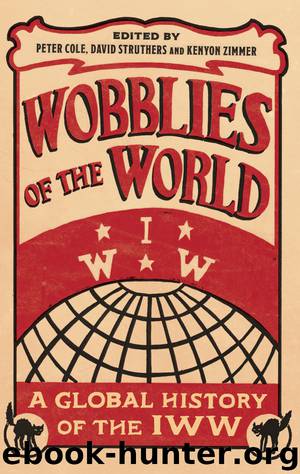
Author:Peter Cole, David Struthers & Kenyon Zimmer [Peter Cole, David Struthers & Zimmer, Kenyon]
Language: eng
Format: epub
ISBN: 9781786801524
Publisher: PlutoPress
Published: 0101-01-01T00:00:00+00:00
9
“We Must Do Away with Racial Prejudice and Imaginary Boundary Lines”:British Columbia Wobblies before the First World War
Mark Leier
Transnationalism may seem an odd concept to apply to people moving back and forth across the US–Canadian border. As settler-colonial states largely populated by immigrants from around the world, neither country is a “nation-state” in the sense of a community sharing a common language, heritage, economy, and culture, especially during the years of the Wobblies’ greatest influence. “American” and “Canadian” were formal, legal labels signifying citizenship rather than a national identity, and citizenship did not erase privileges and stigmas of race and ethnicity. Furthermore, capital and workers flowed easily across the border, and the two countries developed in broadly similar economic and political ways, making national differences less obvious. As Samuel Gompers, longtime head of American Federation of Labor (AFL), put it, “when the Yankee capitalist” crossed the border to “oppress Canadian workingmen … it was but natural that the Yankee ‘agitator’ should follow.”1
That did not mean, however, that the border did not matter. Labor organizers could expect very different reactions in the two countries. When the IWW launched free speech fights in Victoria and Vancouver, British Columbia (BC) between 1909 and 1912, the battles were won with relative ease. In contrast, IWW members in free speech fights in San Diego, California and Everett, Washington in the same period were met with firehoses, beatings, long prison terms, and murder at the hands of vigilantes and police. The two-year strike of coal miners on Vancouver Island between 1912 and 1914 saw workers thrown out of company housing, the militia deployed, and mass arrests, but nothing like the violence of Ludlow, Colorado, where nearly 200 people, including 13 women and children, were killed in armed skirmishes and the blaze caused when the state militia set the strikers’ tent city on fire. Despite the similarities between the two countries, then, the “national” boundary between Canada and the United States could mean a great deal, and so the question of transnational experience still has some meaning.
Gompers also proved mistaken in his assessment of the cross-border movement of union organizers. It was not one-way and not limited to “Yankee” AFL craft unionists. Wobblies in and from British Columbia demonstrated a practical transnationalism as they crossed between the two states to work and organize, and in doing so they proclaimed a radical internationalism while articulating their interests as workers.
Transnationalism and internationalism began at the IWW’s founding convention. Canadian-born John Riordan, representing the American Labor Union (ALU), and James Baker, representing the Western Federation of Miners (WFM), traveled 2,000 miles from the Kootenay region of British Columbia to participate in the deliberations. The two had learned from their experience as miners and union organizers that nationalism was nothing more than an ideology cynically deployed by both governments and capitalists to divide workers. When the ALU and WFM struck in British Columbia, they were red-baited and branded as “foreign” unions. Yet the same governments and corporations that denounced the influence of American unions colluded to bring American scabs across the border to break strikes.
Download
This site does not store any files on its server. We only index and link to content provided by other sites. Please contact the content providers to delete copyright contents if any and email us, we'll remove relevant links or contents immediately.
| Africa | Americas |
| Arctic & Antarctica | Asia |
| Australia & Oceania | Europe |
| Middle East | Russia |
| United States | World |
| Ancient Civilizations | Military |
| Historical Study & Educational Resources |
Cecilia; Or, Memoirs of an Heiress — Volume 1 by Fanny Burney(32640)
Cecilia; Or, Memoirs of an Heiress — Volume 2 by Fanny Burney(32014)
Cecilia; Or, Memoirs of an Heiress — Volume 3 by Fanny Burney(31998)
The Secret History by Donna Tartt(19314)
Sapiens: A Brief History of Humankind by Yuval Noah Harari(14469)
Leonardo da Vinci by Walter Isaacson(13414)
The Radium Girls by Kate Moore(12097)
Sapiens by Yuval Noah Harari(5412)
How Democracies Die by Steven Levitsky & Daniel Ziblatt(5280)
The Wind in My Hair by Masih Alinejad(5142)
Homo Deus: A Brief History of Tomorrow by Yuval Noah Harari(4965)
Endurance: Shackleton's Incredible Voyage by Alfred Lansing(4849)
Man's Search for Meaning by Viktor Frankl(4676)
The Silk Roads by Peter Frankopan(4590)
Millionaire: The Philanderer, Gambler, and Duelist Who Invented Modern Finance by Janet Gleeson(4541)
The Rape of Nanking by Iris Chang(4269)
Joan of Arc by Mary Gordon(4160)
The Motorcycle Diaries by Ernesto Che Guevara(4154)
Stalin by Stephen Kotkin(4010)
